Primarily consists of cardiac muscle called myocardium, whose inner surface is lined with endocardium and outer surface with epicardium
Myocardium:
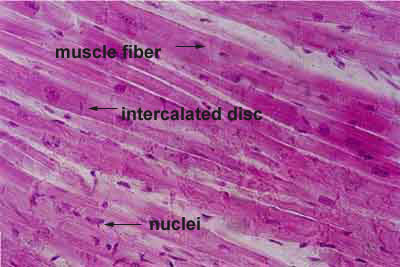
Cardiac muscle is striated as a result of the arrangement of the actin and myosin filaments in the sarcomeres
Cardiac muscles fibers are smaller (about 15 micrometers) than most skeletal muscle fibers (10 - 100 micrometers)
Myocardium consists of individual muscle cells with 1 - 2 centrally placed nuclei which branch, anastomose and are arranged in a linear array, each fiber is about 85 - 100 micrometers long
The junction between two cardiac muscle cells, called an intercalated disk, is another distinguishing feature
The intercalated disk is made up of three types of cell junctions: fascia adherents, desmosomes and gap junctions
Cardiac muscle is more vascularized and has more abundant mitochondria than skeletal muscle (40% of volume vs. 2%); it also contains glycogen granules between the myofibrils
Physiologically, cardiac muscle is intrinsically rhythmic (contracts without outside stimulation) although it is regulated through nervous and hormonal mechanisms
Endocardium:
Lies on luminal side of myocardium
Its inner surface is covered with endothelial cells, a type of squamous epithelium lining the inside of the heart and blood vessels
Beneath the endothelium is a layer of fairly loose, well vascularized connective tissue, which becomes a bit denser closer to the myocardium
The thickness of the endocardium varies inversely with the thickness of the myocardium; i.e. thicker in the atria than the ventricles (which have more substantial muscular walls)
The connective tissue layer closest to the myocardium is slightly looser and is called the subendocardial layer; it contains veins and nerves, as well as the Purkinje fibers when present
Epicardium:
Delicate, inner visceral layer of the pericardium
The outer part of the epicardium is lined with mesothelium: the epithelium lining the walls and contents of the closed cavities of the body, such as the thoracic, pericardial and abdominal cavities
Large blood vessels and nerves are found in the epicardium, and adipose tissue can be abundant
Purkinje fibers:
Modified cardiac muscle cells with a diameter about twice that of regular fibers (30 vs. 15 micrometers)
Contain fewer myofibrils than regular cardiac muscle fibers and have large concentrations of glycogen
Their nuclei tend to be surrounded by a large perinuclear space with the myofibrils well toward the periphery of the muscle fiber
Purkinje fibers are much faster conducting than regular cardiac muscle fibers, with which they make contact via gap junctions